
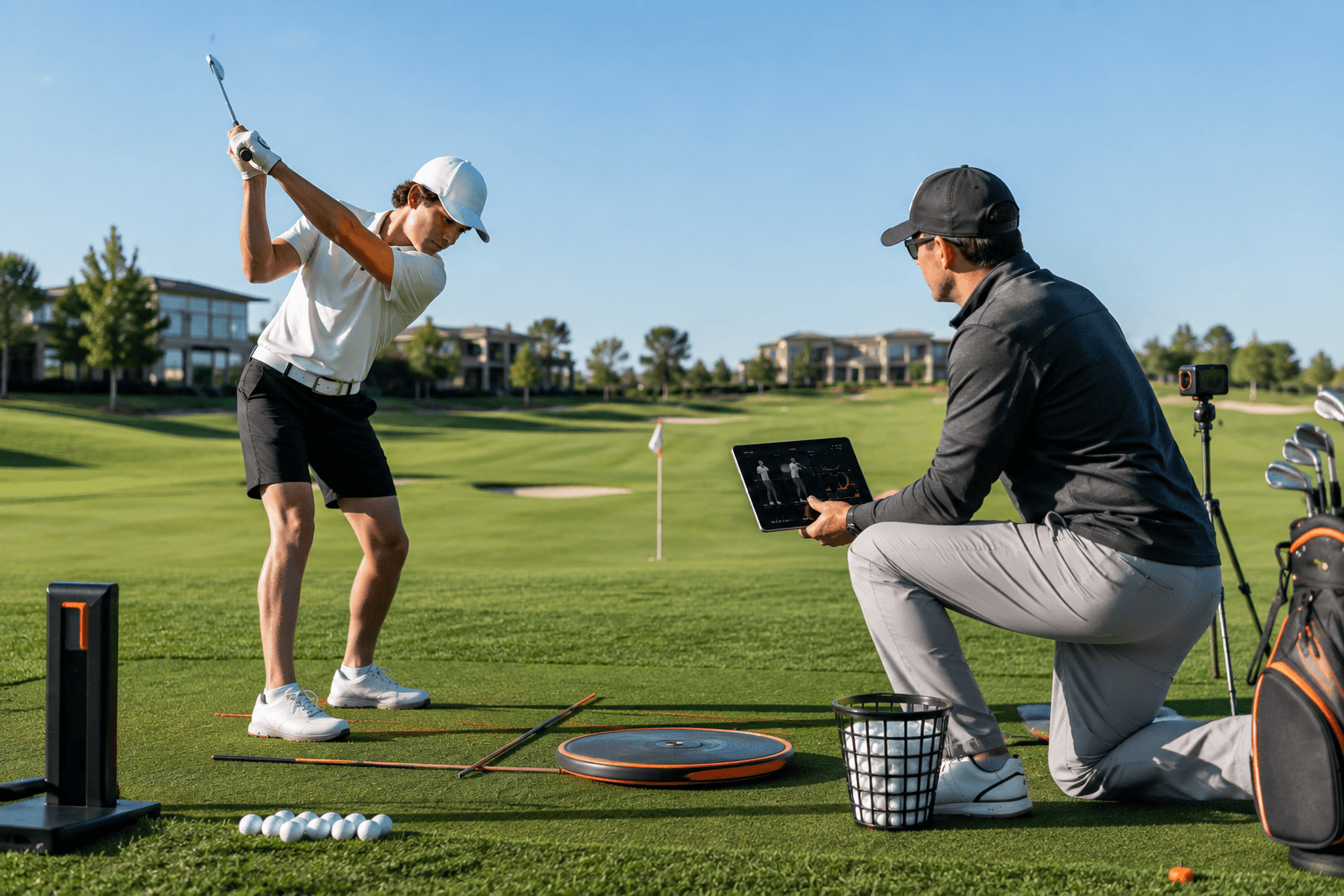
How Golf Biomechanics for Juniors Supports Better Swing Development
Introduction
A junior golfer's swing is constantly changing. Players grow taller, gain strength, improve coordination, and develop new movement patterns—sometimes seemingly overnight. That's why teaching young golfers isn't simply about copying positions from a professional's swing. Golf biomechanics for juniors focuses on how the body moves during the golf swing and how those movements influence efficiency, consistency, speed, and ball striking. Rather than forcing every player into one "perfect" technique, biomechanics can help coaches understand how an individual golfer's body produces a functional swing. For competitive juniors, that matters. Better movement can create a stronger foundation for technical development while helping coaches make smarter decisions as players grow. Families interested in structured player development can explore Campus Golf Academy and available coaching through Find Junior Golf Lessons.
TLDR – Quick Guide
- Golf biomechanics for juniors examines how the body moves throughout the golf swing.
- Biomechanical principles can help coaches distinguish movement limitations from purely technical problems.
- Junior golfers shouldn't be forced to copy one universal swing model.
- Growth spurts can temporarily change balance, coordination, mobility, and swing mechanics.
- Fitness and movement training can support efficient swing development when appropriate for the player's age.
- Launch monitor and performance data can help determine whether movement changes improve actual results.
- Biomechanics works best when integrated with coaching, physical development, and performance tracking.
Detailed Breakdown
What Is Golf Biomechanics?
Biomechanics is the study of movement and the forces involved in producing it. In golf, that means examining how different parts of the body work together to create the swing. A coach considering golf biomechanics for juniors may look at areas such as:
- Posture
- Balance
- Rotation
- Weight or pressure shift
- Hip movement
- Torso movement
- Arm and wrist action
- Sequencing
- Stability
The goal isn't to turn a junior golfer into a walking anatomy textbook. It's to understand whether the player's movement helps or limits their ability to produce consistent golf shots.
Every Junior Golfer Moves Differently
Two golfers can produce similar ball flights with noticeably different swings. That's not necessarily a problem. Players differ in:
- Height
- Limb length
- Strength
- Mobility
- Coordination
- Flexibility
- Athletic background
Those differences influence how they move. Good golf biomechanics for juniors recognizes those individual characteristics instead of demanding that every golfer reproduce identical swing positions. The objective should be functional movement that supports performance—not a swing designed to look perfect in a screenshot.
Growth Can Change the Swing
Junior golfers present coaches with a challenge adults generally don't experience: rapid physical growth. A player can gain several inches in height, become stronger, or experience changes in coordination over a relatively short period. During growth phases, a junior may temporarily struggle with:
- Balance
- Timing
- Posture
- Contact
- Coordination
- Distance control
That doesn't automatically mean the player has developed a bad swing. Sometimes the golfer is simply learning how to control a changing body. Coaches who understand junior development can adjust expectations and training rather than immediately rebuilding the player's technique.
Sequencing Helps Create an Efficient Swing
A golf swing requires different body segments to work together in a coordinated sequence. When movement is well coordinated, players can transfer energy efficiently through the swing. When sequencing becomes inefficient, golfers may compensate with other movements. For example, a player struggling to create effective rotation might rely more heavily on the arms to generate speed. A biomechanical perspective can help a coach investigate why a technical pattern appears instead of merely correcting what it looks like. That's an important distinction.
Mobility Can Influence Technique
Sometimes what appears to be a technical problem may have a physical component. Suppose a coach continually asks a junior to rotate into a particular position, but the player's current mobility makes that movement difficult. More repetitions of the same instruction may not solve the issue. An age-appropriate physical assessment can help determine whether mobility, stability, strength, or coordination is contributing to the pattern. This doesn't mean every swing issue needs a fitness solution. It means physical capability should be considered when appropriate.
Fitness Can Support Better Movement
As juniors develop, age-appropriate athletic training can support their golf performance. Useful areas may include:
- Balance
- Coordination
- Mobility
- Stability
- Strength
- Speed
The purpose isn't to turn young golfers into bodybuilders. It's to develop physical qualities that support athletic movement. Junior Golf Fitness Training for Competitive Performance explores how physical preparation can complement golf-specific development. Training should always reflect the player's age, maturity, abilities, and individual needs.
Biomechanics Can Help Reduce Unnecessary Swing Changes
Competitive golfers can easily fall into a cycle of constant technical adjustment. One week, it's the backswing. The next week, it's the hips. Then someone spots a different position on video. A biomechanical approach encourages coaches to understand the complete movement pattern before changing individual pieces. If a golfer's swing is producing:
- Predictable contact
- Functional ball flight
- Adequate speed
- Repeatable results
then a visually unusual movement may not need immediate correction. Good coaching prioritizes changes that improve function.
Performance Data Keeps Biomechanics Grounded
A swing can look more technically polished without actually performing better. That's why golf biomechanics for juniors should be connected to measurable outcomes. Coaches can examine whether movement changes affect:
- Contact
- Ball speed
- Carry distance
- Dispersion
- Shot shape
- Scoring patterns
Golf Performance Tracking for Junior Golfers provides additional guidance on connecting training decisions to measurable performance. If a change looks beautiful on video but makes the golfer less consistent, that's useful information. Performance still gets a vote.
Launch Monitors Can Add Another Layer of Feedback
Launch monitor technology can help coaches understand what happens to the golf ball when swing movement changes. Depending on the system, measurements may include:
- Ball speed
- Club speed
- Launch angle
- Spin
- Carry distance
- Shot dispersion
That creates a useful connection between movement and outcome. For example, a coach may introduce a movement change intended to improve contact. Launch monitor data can then help determine whether ball speed and dispersion are actually improving. The Golf Launch Monitor Guide for Junior Golfers explains how this type of data can support junior development. Numbers aren't the objective. Better golf is.
Biomechanics Can Support Speed Development
Competitive juniors often want more distance. Understandably so. But simply telling a young golfer to swing harder isn't much of a development strategy. Speed can be influenced by several factors, including:
- Physical growth
- Strength
- Coordination
- Sequencing
- Technique
- Equipment
A biomechanical perspective can help coaches identify whether a player's movement allows them to produce speed efficiently. As players mature physically, training can evolve accordingly. The emphasis should remain on developing usable speed—the kind a golfer can control during competition.
Coaches Should Keep Biomechanics Understandable
Biomechanics can become technical very quickly. Junior golfers generally don't need lectures about every joint angle and force measurement occurring during the swing. A coach's job is to translate complexity into something useful. Instead of overwhelming the player with data, instruction might become:
- One movement cue
- One drill
- One practice objective
Behind that simple instruction may be a sophisticated understanding of movement. That's fine. The golfer needs the solution, not a graduate seminar.
Parents Should Be Careful With "Perfect Swing" Comparisons
Video and social media make it easy to compare a junior golfer with elite professionals. But copying a professional's positions without understanding the player's body, development stage, or movement capabilities can create unnecessary problems. Professional golfers themselves don't all swing identically. Parents should be cautious about telling juniors to copy:
- A professional's backswing
- A particular hip position
- A specific follow-through
- A social media swing tip
The better question is whether the player's current movement supports consistent, efficient performance.
Finding Coaches Who Understand Player Development
Families don't need to become biomechanics experts. They do need coaches who understand that junior golfers are developing athletes. When evaluating instruction, consider asking:
- How do you account for growth and physical development?
- Do you assess movement when necessary?
- How do you decide whether a problem is technical or physical?
- How do you measure whether a swing change works?
- How does training change as juniors mature?
Families can learn more about the coaching philosophy behind About Campus Golf Academy. For players in Texas, New Braunfels Junior Golf Academy offers another starting point for exploring local junior development opportunities.
Common Biomechanics Mistakes in Junior Golf Development
Understanding golf biomechanics for juniors is useful, but it can be applied poorly. Common mistakes include:
- Forcing every golfer into the same swing model
- Ignoring physical growth
- Changing too many movements simultaneously
- Prioritizing appearance over performance
- Overloading juniors with technical terminology
- Treating launch monitor numbers as the goal
- Introducing inappropriate physical training
- Copying professional golfers without considering individual differences
Biomechanics should simplify development decisions—not make golf more complicated for the player.
Key Takeaways
- Golf biomechanics for juniors helps coaches understand how a developing golfer's body creates the golf swing.
- By considering factors such as mobility, balance, sequencing, coordination, physical growth, and individual movement characteristics, coaches can make technical decisions that better match the player in front of them.
- Biomechanics becomes even more useful when combined with performance tracking, fitness development, and launch monitor feedback. Together, those tools can help determine whether a swing change isn't merely different—but genuinely better.
- The objective isn't to manufacture identical golf swings.
- It's to help each junior golfer develop an efficient, repeatable movement pattern capable of evolving as they grow.
- For competitive players, that's a foundation worth building.
Frequently Asked Questions
What is golf biomechanics for juniors?
Golf biomechanics for juniors examines how a young golfer's body moves and produces force throughout the swing. Coaches may consider balance, rotation, sequencing, mobility, and other movement characteristics when evaluating technique. The goal is to support efficient movement that fits the individual player's development.
Can biomechanics help junior golfers improve their swings?
Yes, biomechanical analysis can help identify movement patterns that may influence contact, consistency, speed, or ball flight. It can also help coaches determine whether certain technical issues have a physical component. Any changes should still be evaluated according to how they affect actual golf performance.
How do growth spurts affect a junior golfer's swing?
Growth can temporarily change balance, coordination, posture, timing, and the way a player controls the club. A junior who suddenly struggles may be adapting to changes in height, strength, or limb length rather than experiencing a purely technical problem. Coaches should account for those changes before making unnecessary swing overhauls.
Does junior golf biomechanics require expensive technology?
No, useful movement evaluation can begin with knowledgeable coaching and basic observation or video. More advanced tools may provide additional information, but technology is only valuable when the findings lead to appropriate training decisions. The coach's ability to interpret movement remains essential.
Is golf fitness part of biomechanics for junior golfers?
Physical qualities such as mobility, stability, strength, balance, and coordination can influence how a golfer moves. Age-appropriate fitness training may therefore complement technical development for some junior players. Training should be individualized a